A Lightweight Gearbox can reduce mass without sacrificing the torque, accuracy, or service life your application requires. That balance matters in robotic arms, mobile equipment, and compact production lines. A lighter unit can ease motor loading, simplify mounting, and help a machine respond more quickly. But lower weight alone proves little. Housing stiffness, gear materials, lubrication, and heat control still shape real-world performance.
A useful design principle comes from aviation pioneer Antoine de Saint-Exupéry: “Perfection is achieved, not when there is nothing more to add, but when there is nothing left to take away.” He was not a gearbox specialist, so this is a broader engineering insight, not a gearbox-specific recommendation. Applied carefully, it points to purposeful weight reduction—not removing material without testing. For example, a thinner housing may save mass, yet increase vibration under repeated load. That trade-off deserves attention.
Choosing the right gearbox starts with measured requirements: output torque, duty cycle, speed, mounting space, and operating temperature. Ask suppliers for verified performance data, material details, and test conditions. Compare complete drive systems, too; a lighter gearbox may allow a smaller motor or support. It depends. A mismatch can erase the expected benefit. Real operating tests matter more than a promising catalogue figure. A Lightweight Gearbox is a strong choice when its weight savings fit the machine’s actual demands and its reliability has been demonstrated.
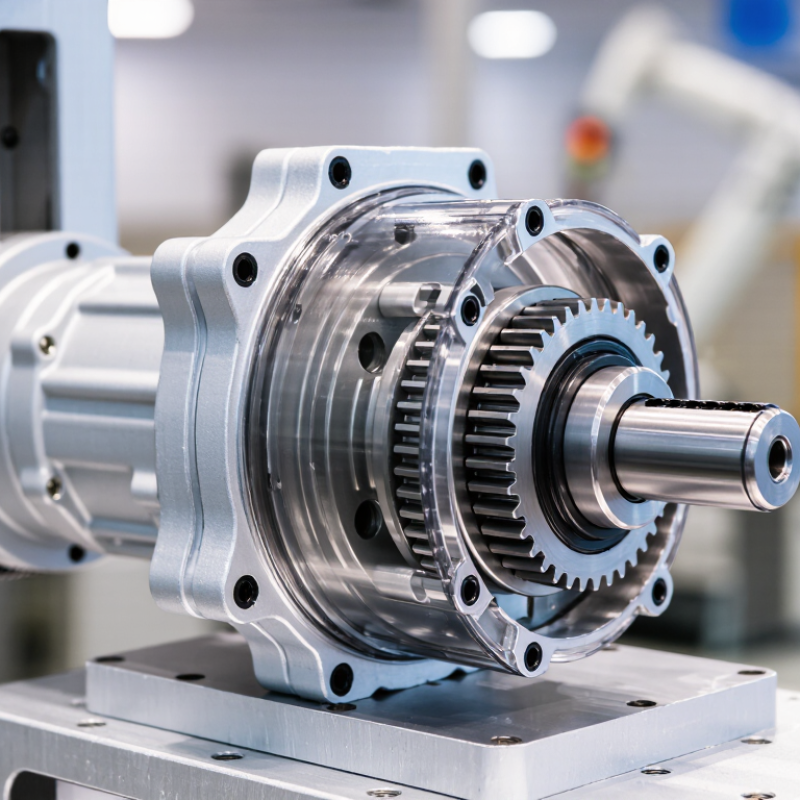
What Defines a Lightweight Gearbox?
A lightweight gearbox is not defined by low mass alone. Engineers usually assess its weight against the torque it can transmit, its operating life, and the space available for installation. This relationship is often called torque density. A compact housing made from aluminum, for example, may reduce weight, but material choice must also account for bearing loads, vibration, and heat. Mass is only one measure.
Inside the gearbox, lighter gears, shafts, and carriers can reduce rotating inertia. That may help a motor accelerate more readily and use less energy during frequent starts and stops. Yet thinner components can flex under load, affecting gear contact and noise. That matters. A practical review checks duty cycle, peak torque, mounting stiffness, lubrication, and cooling—not just the number on a scale. In a small mobile machine, even a modest weight reduction can ease handling and lower support loads. In a fixed, high-load system, the same reduction may offer little benefit. There is no perfect shortcut; a lighter design can demand tighter manufacturing tolerances or more careful thermal checks. Engineers should compare verified load and temperature data with the application’s real operating conditions.
How Gearbox Design Reduces Weight
A lighter gearbox starts with understanding where forces actually travel. Engineers can reduce material in low-stress areas while keeping strength around gear supports, bearings, and mounting points. Thin sections are not automatically better; each change needs to match the torque, speed, and operating cycle.
Gear geometry helps too. Hollow shafts can replace solid ones where the load allows, and carefully shaped gear webs remove excess material without weakening the tooth-bearing rim. Compact layouts, including well-arranged planetary stages, may deliver the required ratio in less space. Every gram matters. Still, heat and lubrication need room to move, so making a gearbox smaller can create new problems.
Housing design offers another opportunity. Ribs placed along real load paths can provide stiffness with less bulk than uniformly thick walls. Lightweight alloys may reduce mass, but their strength, wear resistance, and heat behavior must suit the application. Engineers can compare designs through stress analysis, then check prototypes under realistic loads. That process catches weak spots a drawing may miss. It is tempting to remove material everywhere; sometimes that increases vibration or fatigue risk. The best design is not simply the lightest one, and that trade-off deserves another look.
Performance Benefits of Lower Gearbox Mass
A lighter gearbox can reduce the load carried by a machine frame, vehicle, or robot arm. That can allow designers to use less supporting material or reserve more capacity for a payload. It may also make the assembly easier to position during installation. Small differences matter. A few kilograms can affect balance on a mobile platform or increase the effort needed to handle a large unit.
Lower mass alone does not guarantee better performance. Gearbox weight and rotational inertia are related, but they are not the same; internal design and gear arrangement matter too. On a fast-moving axis, lower inertia may help the motor accelerate and decelerate the system. Check the actual inertia, torque rating, heat limits, and duty cycle before choosing a smaller unit. I would not trade away stiffness or service life just to save weight. That trade-off can be easy to miss.
Tips: Compare complete assembly weights, including mounts and couplings. Confirm the gearbox can handle peak loads, not just normal operation. If possible, test it under the real load and motion profile; estimates can be imperfect.
Why Choose a Lightweight Gearbox?
Example gearbox masses and their equivalent static weight loads
This illustrative example compares gearboxes with the same assumed function. Reducing mass from 10 kg to 7.5 kg lowers the supported static load by about 24.5 N per gearbox, calculated using F = mg and g = 9.81 m/s². Actual acceleration and energy benefits depend on the gearbox design, mass distribution, and application.
Applications That Benefit from Lightweight Gearboxes
Applications That Benefit from Lightweight Gearboxes
Mobile robots and automated guided vehicles gain from lighter gearboxes because every kilogram moves with the chassis. Lower transmission mass can reduce the load on wheels, suspension, and drive motors. In a warehouse, that may mean steadier turns and less energy spent accelerating. The International Federation of Robotics reported 541,302 industrial robot installations worldwide in 2023 in World Robotics 2024. As robotic fleets grow, compact, low-mass transmissions can help designers manage moving loads and tight equipment layouts. Fit matters.
Robotic arms also benefit, especially when a gearbox sits near the wrist. Reducing mass at the end of the arm can ease inertial loads during repeated starts and stops. But lighter housings or gears still need adequate stiffness, heat handling, and service life. A gearbox that flexes under load is not a useful upgrade. Real duty-cycle testing matters more than a low weight on a specification sheet.
Electric vehicles and battery-powered mobile equipment are other candidates. The U.S. Department of Energy’s Vehicle Technologies Office notes that reducing vehicle weight by 10% can improve fuel economy by roughly 6–8%. That figure applies to whole-vehicle lightweighting, not gearboxes alone. Still, it shows why component mass deserves attention. Engineers should weigh the benefit against torque capacity, lubrication needs, and repair access. The compromise can be awkward. A few grams saved may matter less than reliable operation over thousands of cycles.
Key Factors in Selecting a Lightweight Gearbox
Why Choose a Lightweight Gearbox for Your Application?
Key Factors in Selecting a Lightweight Gearbox
Choosing a lightweight gearbox starts with the load, not the scale reading. Check the required torque, speed range, and operating hours. A gearbox that handles a brief peak may struggle during repeated starts or continuous shifts. Not by itself. Low mass does not guarantee suitable performance. Compare the gearbox’s rated output with the real conditions at the shaft, including shock loads and frequent reversals. For a small mobile machine, even a few kilograms can affect battery use, balance, and mounting stress.
Material and design choices matter, but so do heat and maintenance. A compact aluminum housing may reduce weight, yet the application must still shed heat during long cycles. Review the manufacturer’s torque curves, efficiency data, and service recommendations rather than relying on a single headline rating. Also check shaft alignment, available mounting space, and how easily technicians can inspect seals or replace lubricant. Small alignment errors can become noisy problems. It is tempting to choose the lightest option, though that can be a poor trade if it brings excess vibration or shortens service intervals. Leave a practical margin for changing loads, and verify the selection under the conditions the machine will actually face.
|
Why Choose a Lightweight Gearbox for Your Application? - Key Factors in Selecting a Lightweight Gearbox
|
| Housing material |
Typical density (g/cm³) |
Relative material mass* |
Typical elastic modulus (GPa) |
Selection considerations |
| Aluminum alloys |
2.66–2.85 |
About 37–40% |
About 69–72 |
Often used where low mass and heat dissipation are priorities. Check housing stiffness, bearing-seat strength, corrosion protection, and operating temperature. |
| Magnesium alloys |
1.74–1.85 |
About 24–26% |
About 44–46 |
Offers very low material mass, but requires careful consideration of corrosion protection, joining, fire-safety requirements, and application-specific durability. |
| Cast iron |
About 6.9–7.3 |
100% reference |
About 100–170 |
Provides a useful mass reference and can offer good vibration damping. Its higher density may be a drawback when equipment weight or moving mass is constrained. |
| Steel |
About 7.75–8.05 |
About 106–117% |
About 200–210 |
High stiffness and strength make steel useful for highly loaded components and shafts; it is generally heavier than aluminum or magnesium for the same volume. |
|
How to use this comparison: Values are typical material-property ranges and vary with alloy, grade, and processing. Relative material mass is estimated for an equal volume, using cast iron at 7.2 g/cm³ as the reference. It does not represent the weight reduction of a complete gearbox: actual mass also depends on geometry, gears, shafts, bearings, lubrication, and required load capacity.
|
Conclusion
A Lightweight Gearbox is designed to deliver reliable power transmission while minimizing mass through careful choices in materials, component layout, and housing design. Reducing weight does not simply mean making every part smaller; engineers must balance strength, stiffness, durability, and thermal performance so the gearbox can handle its intended loads. A well-designed unit can lower the overall mass of a machine without compromising dependable operation.
Lower gearbox mass can improve efficiency, responsiveness, and ease of installation, particularly in equipment where every kilogram affects movement or energy use. These advantages can benefit robotics, mobile machinery, aerospace systems, and other weight-sensitive applications. When selecting a lightweight option, consider torque and speed requirements, duty cycle, operating conditions, mounting constraints, service life, and maintenance needs. The best choice is one that meets the application’s performance demands while providing a practical balance of weight, strength, and long-term reliability.

 Lahabra Motors